SAVAGE CONCEPTS
Design Terrains - Expanded Project
Concepts
Concept 1-
The outcome to project 1 was all about using past images of Plymouth to evoke a sense empathy and to greater build a sense of identity within the city. Reflecting on the way that the senses can add layers to experiences and trigger memories, I would look to add this to the experience of the older images of Plymouth to create a full experience of the area.
Concept 2
A workshop learning experience for children, harnessing the smell (and possible taste) of fruit to enhance the message of food and our waste. Through using the power of smell, the memory of the workshop would be recalled, whilst using the potential from Industry 5.0 to develop emotion connection through manual processes and experiences.
This would be a development of a workshop to teach children to think about what they do with their waste, as opposed to it being for someone else to deal with once it is in the bin, encouraging a sense of responsibility and care. Using scent to create a memory to be unlocked at another point when older.
At the end of this workshop, the children should be able to come away with an understanding that waste does occur in everyday life, but to encourage a mindset of curiosity about what could happen to it next. They would also be able to come away with something that they have made to remind them of the workshop, but also as a success and sense of achievement about what they can do to change things.
I would look to start this workshop with where the bananas that come to the uk come from. According to the fairtrade website with facts about bananas, they mostly come from Latin America.
Fairtrade Foundation (2023) Top 12 facts about fairtrade bananas, Fairtrade Foundation. Available at: https://www.fairtrade.org.uk/media-centre/blog/top-12-facts-about-fairtrade-bananas/#:~:text=Originally%2C%20bananas%20came%20from%20Asia,Latin%20America%20and%20the%20Caribbean. (Accessed: 09 January 2024).
However according to Our World in Data, bananas production is widely spread across India as well. https://ourworldindata.org/grapher/banana-production?time=latest
From this I would look to use the map from our world in Data to show the hotspots for Banana growing.
I would then go on to encourage the kids to et the banana and notice the smell and taste of it. By doing this, it would encourage their senses to engage with the topic that we are talking about.

I would then go on to encourage the kids to eat the banana and notice the smell and taste of it. By doing this, it would encourage their senses to engage with the topic that we are talking about. This would be encouraged by using descriptive words to engage with other areas of the mind to help encourage that memory. This links back to a quote on my previous page, about smell short-circuiting the other senses for memory.

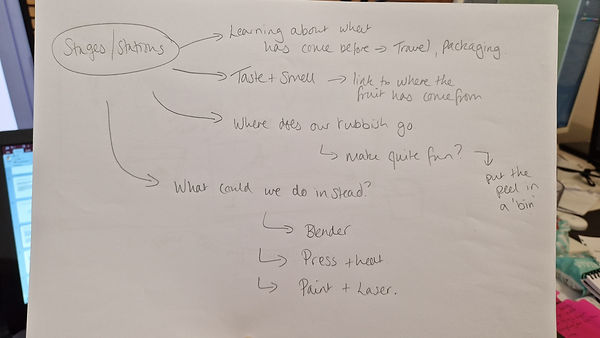
The students would then be encouraged to put their peel into the 'bin' which in fact would be a conveyor belt that takes the peel along its journey. This will make key piece of information make them selves known as the peel goes along. The kids would be in charge of making the conveyor move - showing that to throw rubbish out takes energy too.

A little mock-up, showing the process from learning about where the bananas have travelled from and other facts about that, on to a basket for bananas, dropping the peel into the 'bin' which is a human powered conveyor belt. This then travels through the facts about waste and what happens to it before being loaded onto the ramp. At this point there are critical questions being asked of the kid. The ramp stops at the base of the the next stand which has a blender and an oven behind the scenes. The banana peel goes into the blender before going into a coaster mould, which has pressure and heat applied to it to remove the excess water and give compression to the mix for it to bond.
The last station is for personalisation, where you can stencil, screen print or laser rasterize your coaster.
Through this multi-sensual experience of the process from eating and 'dealing' with the waste, it would make memory of what has been learnt and completed more likely to be retained and triggered at a later date.